
What is STAGES?
STAGES is a model of ego development starting at infancy and moving into increasing levels of differentiation and integration through adulthood.
STAGES is a model of ego development that describes how humans grow in their ability to make meaning from infancy through adulthood. Each stage represents a consistent way of thinking, feeling, and behaving, shaping how a person understands life experiences.
Building on Jean Piaget’s developmental stages, STAGES extends the idea into adulthood with 12 stages and 6 types of perspectives, ranging from basic self-awareness to highly advanced forms of consciousness.
Based on Loevinger/Cook-Greuter model and overlaid with Ken Wilbers AQAL-framework. Terri O´Fallon, PhD, identified a set of underlying parameters that explain the progression of the developmental levels. the model focuses on how perspectives evolve over time.
Rather than being a simple hierarchy, STAGES shows development as an expansion of awareness—where people increasingly become able to observe their thoughts, emotions, and relationships instead of being unconsciously controlled by them.
The STAGES model was developed by Terri O’Fallon, PhD, an integral scholar and educator whose research in human development spans more than four decades.
Kristiina Krank
Certified Stages Scorer and Debriefer
I have been interested in growth and development from a young age. Over the years, that curiosity has become both a personal path and a professional calling.
I am known for my calm, grounded presence and for creating safe, confidential spaces—whether I am working with individuals or within organizations.
I listen with care and attunement, supporting individuals and teams in exploring their developmental story, supporting clients, leaders, and teams recognize their potential and broaden their perspective. I weave developmental insights into our conversations in a natural and accessible way, checking in to ensure clarity and shared understanding. One of my strengths is highlighting what is working in the moment and helping people see themselves in new, empowering ways.
In my sessions, I offer practical and clearly explained growth practices that participants describe as being relevant and realistic. I deeply value the transformative power of a Assessement and debrief. My debriefs and workshops are structured, engaging, and practical. I integrate developmental insights seamlessly, support leadership and collaboration, and contribute to cultural development within organizations.
I offer STAGES Assessments for individuals and organizations seeking new perspectives on leadership, communication, and human development. I have led workshops in Sweden and internationally on adult development and consciousness, provide one-on-one coaching.
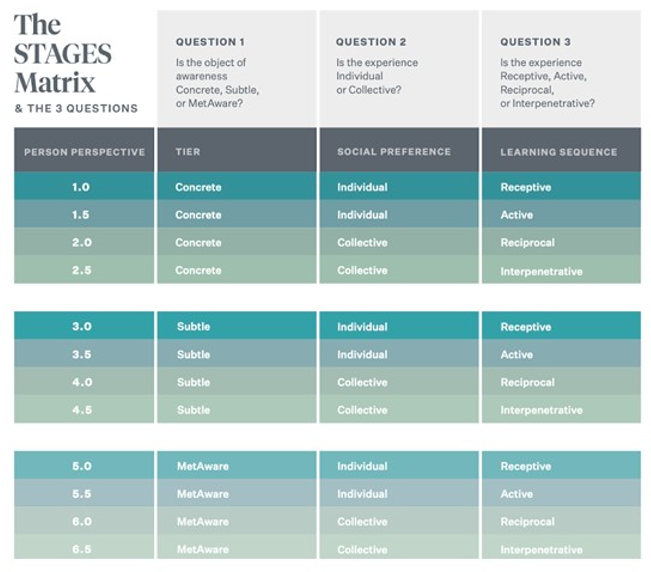
The STAGES model
The STAGES model can predict how we are likely to understand our experience of ourselves and our world.
The STAGES model offers a framework for understanding how people are likely to experience themselves and interpret the world around them. Rather than predicting what someone will believe, it illuminates how those beliefs are structured and held. For instance, a fundamentalist style of thinking is not limited to religion—it can shape someone’s approach to science, atheism, politics, or personal relationships. By mapping different stages of ego development, STAGES helps us recognize the underlying patterns through which people create meaning in their lives.
This deeper insight allows for more skillful communication. When we understand how both we and others are making sense of their experiences, values, and challenges, we can listen with greater accuracy and respond in ways that truly resonate. The result is more effective, respectful, and compassionate interaction. STAGES certifications and assessments are designed to support professionals who apply the model in coaching, therapy, leadership, education, and other developmental contexts.
The model is used internationally by individuals and organizations seeking clearer insight into human development. Therapists, coaches, and educators rely on it to better support their clients and students. Organizational leaders apply STAGES to evaluate developmental capacity, strengthen leadership effectiveness, and improve motivation. Companies use it to assess workplace culture, team dynamics, and communication patterns, fostering greater alignment and productivity. In academic settings, STAGES informs research and dialogue across diverse fields such as climate change, psychology, education, conflict resolution, economics, and social justice.
What is a STAGES Assessment?
A STAGES assessment is a guided process that helps you understand how you make sense of yourself and the world. It looks at your way of thinking and meaning-making — how you interpret experiences, relationships, challenges, and values. Everyone develops over time, and the assessment identifies your “center of gravity” — your most typical way of making sense of life — while also showing your broader developmental range.
How It Works
The assessment is based on a sentence-completion exercise. You are given 36 open-ended sentence prompts and asked to finish them in your own words. Your responses are then carefully reviewed and scored by a certified STAGES analyst, Kristiina. The scoring process is detailed and designed to identify patterns in how you think and interpret your experiences.
What You Receive
After the assessment, you receive:
- A detailed 12–20 page report
- A description of your strengths and growth areas
Insights into common stress or “shadow” patterns - Practical suggestions for development
- A 1 hour debrief session with a certified practitioner to walk through the results and answer questions
How It’s Different
Unlike many assessments that measure skills or personality traits, STAGES looks at deeper emotional, social, and even unconscious patterns. It focuses on how you think and experience life — not just what you think.
Many people choose to continue their growth through coaching or therapy with certified STAGES professionals after completing the assessment.
In simple terms, a STAGES assessment is a structured way to better understand your current developmental perspective — and how you can continue growing from there.
Benefits of having a STAGES Assessment
A STAGES assessment helps individuals understand how they are developing in maturity, perspective-taking, and self-awareness. It provides a “map” of how consciousness grows, helping people navigate life challenges and create a more meaningful and satisfying life.
The model offers insight into personal strengths, growth areas, and long-term potential, and can be applied to relationships, parenting, leadership, work, and spiritual development.
Key Benefits:
- Greater self-understanding
- Clear awareness of strengths and growth edges
- Insight into your developmental patterns
- Awareness of shadow or unconscious patterns that may be blocking you
- Improved relationships and communication
- Increased clarity about your perspectives
- Support for growth in purpose, leadership, and life satisfaction
For Professionals
STAGES assessments help professionals such as therapists, counselors, coaches, and consultants provide deeper and more transformative insights for their clients. They are also useful in organizational settings, including leadership development, team building, executive coaching, and consulting.
Unlike many self-report assessments, STAGES is psychometrically validated and grounded in extensive research. Assessments are scored and debriefed by certified practitioners who complete rigorous training and testing. Results include a Core Score and detailed narrative material that supports personal insight and meaningful change.
STAGES emphasizes ethical use, recognizing that a single score cannot fully capture a person’s complexity, and it is not intended for high-stakes decisions like hiring or firing. When used responsibly by trained professionals, the assessments can guide individual and group development, support research, compare cohort mindsets, and measure the impact of interventions.
How do I purchase STAGES Assessment
Standard Assessment for individuals
36 items, with Report and 60 minute Debrief.
The personalized Report includes analysis for leading edge, trailing edge and shadow, state/stage, patterns and themes (in four categories: interiors, actions, relationships, and systems orientation), and recommended practices.
The questions in the profile are written in English, and all your responses should also be provided in English.
Email Kristiina for more information and purchase.
Price: 7.300,- SEK
Leadership Assessment
The Leadership Assessment has 36 stems specialized for organizational insights and leadership development. The assessment includes a Report and 60 minute Debrief.
The questions in the profile are written in English, and all your responses should also be provided in English.
Email Kristiina for more information and purchase.
Price: 8.200,- SEK
In case you have any questions, please do not hesitate to contact Kristiina